

Frederick Wardy
https://www.frederickwardy.com/
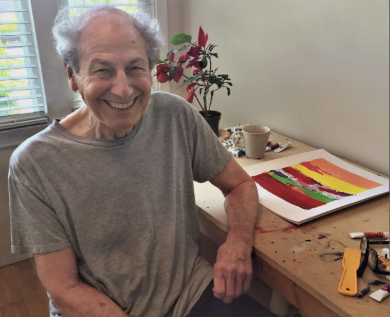
Frederick Julian Wardy (born in 1934) is a prolific abstract painter and sculptor who has worked in many styles and mediums, producing paintings, works on paper, and sculpture. His art career began in the late 1960s and continues to the present.
Wardy’s paintings on canvas and works on paper usually have complex interactions of color or of line and demonstrate an ambitious control of mediums. They reveal a love of color and, in some cases, a fascination with the possibilities of black and white. Wardy’s acrylic and oil paintings on canvas vary in size (from 10″ x 8″ to 8' x 6') as do his works on paper (from 5″ x 3″ to 29″ x 20″). The latter are made with various combinations of gouache, ink, lead or graphite pencil, charcoal, pastels, pastel stick, and oil stick. Wardy has produced sculptures in iron, steel, cut wood, twigs, canvas, and plaster. His sculpture sometimes shows a kinship with examples of his two-dimensional works in the use of linear elements and directional movement.
Wardy Surfboards
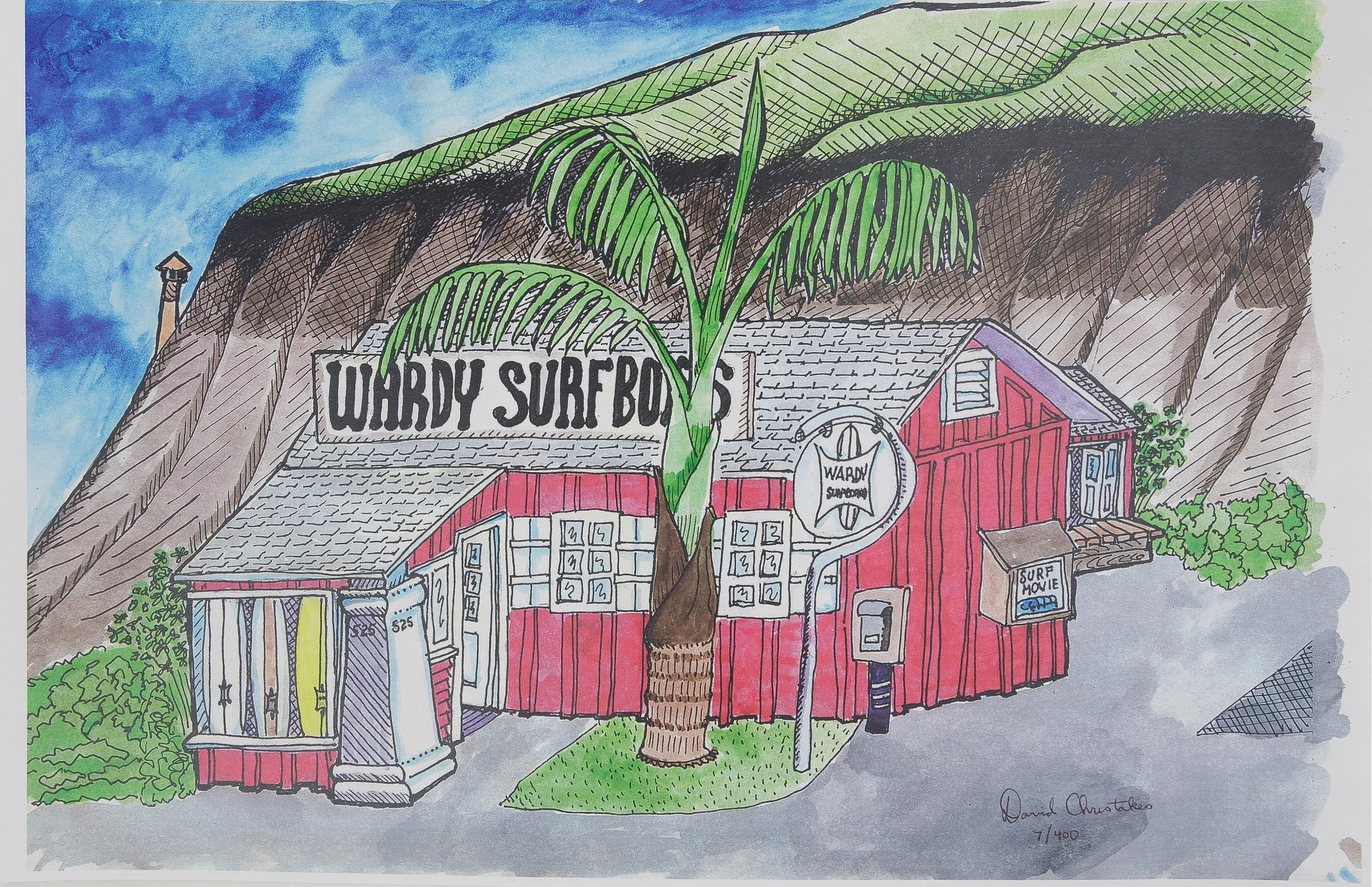
Wardy established Wardy Surfboards in Laguna Beach in 1959 and made surfboards there from 1959 to 1967. His name and surfboards are part of surfing lore in California and Hawaii.
Painter and Sculptor
Wardy’s career as an artist began in the late 1960s in Los Angeles and continued in New York City, where he maintained a studio in the Tribeca district of Manhattan for more than thirty-five years. Beginning in the late 1990s, he also maintained a studio on the Olympic Peninsula in Washington State. He currently lives in Manhattan and in Long Beach, California, and is represented by Corina Belle-Isle at Lille Gallery in Wellfleet, MA.
Wardy’s early work met with critical attention. In 1967, he became affiliated with the Los Angeles Art Association Gallery and in 1968 and 1969 with the Nicholas Wilder Gallery, also in Los Angeles. In September 1970, he participated in a group show at the Pasadena Art Museum. Wardy moved to Manhattan in early 1970.
Within a year, Wardy and a group of fellow artists moved to a five-floor building not far away on Thomas Street, between West Broadway and Church Street, in part of a neighborhood later known as Tribeca. Wardy’s first floor was the largest floor in the building at 2,497 square feet.
Willard Gallery in New York began to represent Wardy in the early 1970s, and he had his first one-man show there in 1974. Other solo and group shows followed. As part of group shows, Willard sent Wardy’s work to other cities, including Los Angeles, San Diego, and San Antonio. Located on Madison Avenue and 72nd Street, Willard was one of New York’s most prestigious and historically significant galleries.
In 1976, Galerie Veith Turske in Cologne, Germany, also began to represent Wardy. Wardy’s work was exhibited in numerous museums and galleries in various European cities, and at several international art fairs, including ones in Bologna and Dusseldorf.
The first critical reviews of Wardy’s work at Willard helped to establish him within the art world and brought his art to the attention of many collectors. Reviews by critics included ones by Thomas Hess, in The New York magazine; John Canaday and Hilton Kramer in The New York Times; Judith Tannenbaum in Arts Magazine; and Phyllis Derfner in Art International.
Wardy has produced a large output throughout his career: his twenty-nine abstract stylistic periods and many miscellaneous works. His love of seeking out new experiences and exploring new skills, as well as his consistent energy, reveals themselves in this output and in his use of many mediums.
Wardy’s work has entered many institutional and private collections, including those of the Museum of Modern Art, New York; the Phillips Collection, Washington, D.C.; the Minnesota Museum of Art, Saint Paul; the San Diego Art Museum; the Sprengel Museum, Hanover, Germany; and the Neue Galerie der Stadt, Linz, Austria. Since the late-1980s, Wardy’s work has been represented by private dealers and sold directly by him from his studio.
In the early 1980s, Wardy began spending summers on the Olympic Peninsula in Washington State, near the small town of Sequim. With his work continuing to sell through private dealers or from his New York studio, Wardy spent more time working in Sequim beginning in the late 1990s. His output included not only paintings and works on paper but also three series of sculpture.
Wardy has frequently expressed excitement over creating art. In many notebooks, has written down his thoughts about art,
“Making art is a great joy, the essence of art is to have pleasure in giving pleasure, true innovation comes from artists steeped in tradition, and I’ve jammed myself full of art history”.
“I have wanted to make things unique, and I have also had a strong compositional sense and a willingness for variety. I have been interested in overall harmony and unity but have tried to create lively multi-directional movement—whether repetitive or greatly varied. I have used active lines and/or strokes, done free hand, except for only one series. The lines dominate or are upon fields of color. With sculpture, I have also conveyed movement and energy, something alive and not moody, not flat but vigorous.” (Frederick Wardy, 2020)
In 2020, Wardy spoke as follows about his life as artist in New York City,
New York was and still is the art capital of the world, with many great museums and the bulk of major artists. That does not mean that if you produced art in New York that it was good, however. There were many opportunities for exhibiting and selling, perhaps matched only by Paris. The number of artists and galleries was overwhelming.
“There were many opportunities to meet great artists, including Willem de Kooning, Jim Dine, and Peter Agostini, and to see and discuss their work in their studios. The generosity of artists willing to show me their art and their encouragement helped to open the New York art world to me. Meeting so many artists was an enriching experience. The number of artists who were successful was just amazing. Their work went out into the world. You could go to bars where artists congregate, but you did not have to drink, just talk. There was such openness. As time went on, the New York art scene grew even larger, and you could continue to see art of every range, everything from conceptual to abstraction and more. The more you look at art, it not only gives you pleasure but makes you become a better artist.”
Available Works
Wardy is represented by Lille Gallery. To inquire about works seen at Lille Gallery or to purchase works from the
Black Lines Series or Colored Bands Series email info@lillegallery.com or call 617-894-4673.